


BRnX Travel

Sign Up > Maximize your true earning potential > Get your rental

 19.65.030. Restrictions and standards

https://mauico-hi.elaws.us/code/coor_title19_artiv_ch19.65_sec19.65.030?utm_source=chatgpt.com

A.
The short-term rental home use is permitted in no more than two single-family dwelling units per lot, except that short-term rental use shall not be permitted in any accessory dwelling pursuant to chapter 19.35 of this title. No more than one short-term rental home permit shall be approved for any lot, except when lots are subject to a condominium property regime pursuant to chapter 514A or 514B, Hawaii Revised Statutes, the following shall apply:

1.
If the applicant owns all condominium units on the lot, only one permit may be granted for that lot.

2.
If the applicant does not own all condominium units on the lot, each condominium unit will be considered a lot for purposes of this chapter and each unit owner will be eligible to apply for a short-term rental home permit, except that no owner may hold more than one short-term rental home permit.

3.
Irrespective of ownership, each condominium unit shall be considered a separate lot for purposes of notification and planning commission review thresholds pursuant to subsection 19.65.060(A)(2).

4.
For the purposes of this chapter, any reference to a short-term rental home property shall mean a property, lot, or condominium unit.

B.
Each permitted dwelling unit on a short-term rental home property shall be rented to one group with a single rental agreement, except:

1.
On the island of Lanai.

2.
Any short-term rental home where the owner resides on an adjacent lot.

C.
The permit holder shall have a current transient accommodations tax license and general excise tax license for the short-term rental home.

D.
The permit holder shall:

1.
Hold a minimum of a 50 percent interest in the legal title to the lot on which the short-term rental home is located, except as provided in subsection 19.65.030(G).

2.
Serve as manager of the short-term rental home; provided that, the permit holder may designate:

a.
An immediate adult family member of the permit holder to serve as manager. Immediate family includes a person’s parents, spouse, children and their spouses, siblings, stepparents, stepchildren, adopted children and their spouses, and hanai children.

b.
An individual with an active State of Hawaii real estate license to serve as manager, except for properties located in the Hana or Lanai community plan areas, where an individual may act as a manager as allowed by State law.

c.
An adult to serve as a temporary manager for up to forty-five days in a twelve-month period.

3.
The permit holder shall notify the department and the immediate adjacent neighbors of:

a.
Any designation of an individual as manager pursuant to this section, including a statement of the designated manager’s tenure, residential and business addresses, and telephone numbers.

b.
Any change in the manager’s addresses or telephone numbers.

E.
The manager of the short-term rental home shall:

1.
Be accessible to guests, neighbors, and County agencies. For purposes of this section, “accessible” means being able to answer the telephone at all times, being able to be physically present at the short-term rental home within one hour following a request by a guest, a neighbor, or a County agency, and having an office or residence within thirty driving miles.

2.
Ensure compliance with State department of health regulations, this chapter, permit conditions, and other applicable laws and regulations.

3.
Enforce the house policies.

4.
Collect all rental fees.

F.
The short-term rental home shall only be rented when the manager is accessible.

G.
The short-term rental home permit is issued in the name of the applicant, who shall be a natural person or persons holding a minimum of a 50 percent interest in the legal title in the lot; except that, a permit may be issued for a lot owned by a family trust, a corporation, a limited liability partnership, or a limited liability company if the following criteria are met:

1.
The applicant is a natural person or persons who is a trustee or who are trustees of the family trust, or who represents 50 percent or more of the partners of a limited liability partnership, 50 percent or more of the corporate shareholders of a corporation, or 50 percent or more of the members of a limited liability company.

2.
The limited liability partnership, corporation, or limited liability company is not publicly traded.

3.
All of the trustees, partners, corporation’s shareholders or limited liability company’s members are natural persons, and if there is more than one trustee, partner, shareholder, or member, they shall be related by blood, adoption, marriage, or civil union.

H.
An applicant may hold no more than one short-term rental home permit, except when:

1.
Additional permits are for short-term rental homes that each have a County assessed market value of $3,200,000 or higher at the time of each application.

2.
The permit holder filed complete applications for the short-term rental home permits within one year of this chapter’s original effective date of May 23, 2012.

I.
A permit is not transferable; except a permit may be transferred upon the death of a permit holder to an immediate family member as defined in subsection 19.65.030(D)(2)(a).

J.
The applicant shall provide with the application, copies of any applicable homeowner or condominium association bylaws or rules and any other applicable private conditions, covenants, or restrictions. The documents, if any, shall assist the department in determining the character of the neighborhood.

K.
The number of bedrooms used for short-term rental home use on a short-term rental home lot shall be no greater than six on Lanai and Maui, and no greater than three on Molokai. The total number of guests staying in the short-term rental home at any one time shall be no greater than two times the number of bedrooms.

L.
Single-station smoke detectors shall be installed in all guest bedrooms.

M.
Single-family dwellings used as short-term rental homes shall not qualify for real property tax exemptions permitted pursuant to chapter 3.48 of this code.

N.
Short-term rental homes shall conform to the character of the existing neighborhood in which they are situated. Prior to issuing a permit, the department or applicable planning commission shall consider the following:

1.
If a proposed short-term rental home property is subject to any homeowner, condominium association, or other private conditions, covenants, or restrictions, then correspondence from the association or other entity responsible for the enforcement of the conditions, covenants, or restrictions is required. The correspondence shall include specific conditions that determine whether or not the proposed short-term rental home use is allowed. The correspondence shall be used to assist the department in determining the character of the neighborhood. If no such association or entity exists, this requirement shall not apply. The director and the planning commissions shall not be bound by any private conditions, covenants, or restrictions upon the subject parcel. Any such limitations may be enforced against the property owner through appropriate civil action.

2.
Existing land-use entitlements and uses.

3.
The applicable community plan.

4.
Community input.

5.
Potential adverse impacts, including excessive noise, traffic, and garbage.

6.
The number of permitted short-term rental homes surrounding the proposed short-term rental home property and their distance to the property.

7.
The number and substance of protests to the short-term rental home application and protests related to the cumulative short-term rental homes in the neighborhood or area.

8.
Existing or past complaints about rental operations on the property.

9.
Existing or past noncompliance with government requirements and the degree of cooperation by the applicant to become compliant.

O.
Short-term rental homes shall be limited to single-family dwelling units constructed at least five years prior to the date of application for the short-term rental home permit, and the dwelling unit shall be owned by the applicant for at least five years prior to the date of application.

P.
A two-square-foot sign shall be displayed along the main access road of the short-term rental home identifying the valid short-term rental home permit, a twenty-four-hour telephone number for the owner or the manager, and a telephone number for the department. The signs shall not be subject to the provisions of chapter 16.13 of this code.

Q.
The permit holder or manager shall prominently display “house policies” within the dwelling. The house policies shall be included in the rental agreement, which shall be signed by each registered adult guest. At a minimum, the house policies shall include:

1.
Quiet hours from 9:00 p.m. to 8:00 a.m., during which time the noise from the short-term rental home shall not unreasonably disturb adjacent neighbors. Sound that is audible beyond the property boundaries during non-quiet hours shall not be more excessive than would be otherwise associated with a residential area.

2.
Amplified sound that is audible beyond the property boundaries of the short-term rental home is prohibited.

3.
Vehicles shall be parked in the designated onsite parking area and shall not be parked on the street.

4.
No parties or group gatherings other than registered guests shall occur.

R.
The County shall be restricted in approving the number of permits for short-term rental homes as distributed per the following community plan areas and as further restricted by the applicable community plan:

1.
Hana: 30.

2.
Kihei-Makena: 100; with no more than five permitted short-term rental homes in the subdivision commonly known as Maui Meadows.

3.
Makawao-Pukalani-Kula: 40.

4.
Paia-Haiku: 88.

5.
Wailuku-Kahului: 36.

6.
West Maui: 88.

The council shall review the community plan short-term rental home restrictions when the number of approved short-term rental homes exceeds 90 percent of the restriction number. Short-term rental homes operating with a conditional permit pursuant to chapter 19.40 of this title that meet the criteria of this section shall be included in the number of short-term rental homes permitted pursuant to this subsection.

S.
Prior to issuing a permit, the director or planning commission may impose conditions for a short-term rental home if the conditions are reasonably designed to mitigate adverse impacts to the neighborhood.

T.
Any dwelling unit developed pursuant to chapter 201H, Hawaii Revised Statutes, or chapter 2.96 of this code shall not be used as a short-term rental home.

BRnX Verified. BRnX Accredited. BRnX Trusted.
That’s how you meet the new traveler where they are.

👉 Accredit your property and redefine luxury

Spring 2025 state short-term rental bills to watch

https://www.rentresponsibly.org/spring-2025-state-short-term-rental-bills-to-watch/?utm_source=chatgpt.com

Paris Achen | Updated on September 19, 2025

State legislatures around the nation are back in session. Since 2021, state short-term rental bills have increased steadily each year, and this year is no exception. As of March 10, 220 state bills containing STR and vacation rental terms have been filed. Below is a list of some of the most important ones to watch so far.

Alaska House Bill 139

A state lawmaker has proposed groundbreaking legislation that could make Alaska the first state to offer its Governor’s mansion as a short-term rental when not in official use.

“This bill would look at the governor’s mansion as an asset that we try to fund and try to be innovative in ways to try to make some of these things pay for their own expense,” said Rep. Will Stapp, R-Fairbanks, who introduced the legislation.

Under HB 139, the Governor’s mansion, built in 1912 in Juneau, could be rented for weddings, receptions, or even short-term stays, like those offered on Airbnb or Vrbo, during periods when the legislature is not in session, and the Governor is not in residence.

Final update: HB 139 received a hearing in the House State Affairs Committee on April 22, 2025, but never received votes from the House and Senate before the legislative session adjourned on May 20, 2025.

Arkansas HB 1445

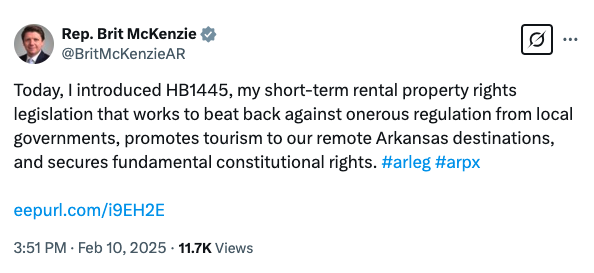
The Arkansas State Legislature is considering a bill that would prohibit local governments, such as municipalities and counties, from enacting or enforcing any ordinance that effectively prohibits or limits the use of a property as a short-term rental.

Bill sponsor Rep. Bill McKenzie, in a post on X, described HB 1445 as “property rights legislation that works to beat back against onerous regulation from local governments, promotes tourism to our remote Arkansas destinations, and secures fundamental constitutional rights.”

During a hearing on Feb. 12, 2025, he stated that the bill would not “take away a single right of local law enforcement to enforce nuisance ordinances.”

The bill would allow local governments to revoke an STR license if the property has three nuisance ordinance violations.

Some local government officials testified in opposition to the bill, saying it would prevent them from adequately addressing citizen concerns and regulating STRs according to local needs.

The City, County, & Local Affairs Committee passed the bill 11-9 on Feb. 12, 2025, after the nearly three-hour hearing.

Final update: HB 1445 was never considered by the full House of Representatives before the end of the Arkansas legislative session on May 5, 2025, so the bill is now dead.

Colorado HB 25-1247

House Bill 25-1247 would increase the cap on the county lodging tax from 2% to 6%. The tax applies to the purchase price for rooms or accommodations, including short-term rentals. If the bill is approved, any county in Colorado could raise the tax to up to 6% with voter approval.

Revenue from the tax currently may be used for:

  • Local tourism promotion
  • Housing and childcare for tourism workers
  • Facilitating or enhancing visitor experiences

Under HB25-1247, the revenue could also be used for:

  • Public infrastructure maintenance and improvements
  • Nature preservation and promotion of sustainable tourism practices
  • Cultural and historical preservation
  • Public safety

The Colorado House of Representatives approved the bill 42-20 on March 10, 2025, while the Senate approved the bill 44-18 on April 11, 2025.

“While lodging taxes already contribute significantly to state and local funding, this bill proposes expanding the allowable uses of these taxes in ways that may not align with the original intent of supporting tourism and lodging-related infrastructure,” Mile High Hosts said in an alert to members.

“We believe that if lodging tax revenue is increased, it should be allocated toward initiatives that directly address housing solutions, as this has been a key focus of recent regulations affecting short-term rentals. However, any changes to how these funds are used should be approached thoughtfully, ensuring they don’t place an unfair burden on guests and the vacation rental community.”

Final update: Colorado Gov. Jared Polis signed the final version of HB25-1247 into law on May 13, 2025.

Florida House Bill 7033


In a move that could reshape Florida’s vibrant tourism industry, lawmakers have proposed dissolving the state’s local Tourist Development Councils by the end of 2025.

Revenue from the state Tourist Development Tax–a bed tax collected from guests staying in hotels, motels, and short-term rentals–currently funds local tourism marketing efforts through county Tourist Development Councils (TDCs).

HB 7033, a large tax package, would abolish all 62 of the state’s TDCs and redirect Tourist Development Tax revenue toward property tax credits, beginning in 2026, according to Florida Politics. Meanwhile, House Bill 1221 would make all Tourist Development Taxes automatically expire every eight years. 

Both bills passed the Florida House of Representatives on April 25, 2025, and are now being considered in the Senate.


Final update: The Senate referred HB 7033 and HB 1221 to the Appropriations Committee, where both bills died on June 16, 2025.

Idaho S 1162


The Idaho Legislature is considering Senate Bill 1162, which bars cities and counties from passing any ordinance that prohibits short-term rentals. The legislation would allow local governments to enact ordinances to regulate STRs so long as the regulations “do not impose different restrictions or obligations on the short-term rentals than are imposed on single-family dwellings or similar structures not used as short-term rentals.”
This bill would effectively prohibit ordinances that require:

  • Owner occupation
  • Professional property management
  • Caps on the number of STRs
  • Limits on the number of rented nights
  • Internal or external signage, notices, or diagrams
  • Notices to neighbors
  • Conditional use permits in a residential zone

The bill also classifies STRs as nontransient residential for zoning and building code purposes. Cities and counties may require STRs to apply for an annual business license with a fee of no more than $50 and may revoke the business license of any STR that has three or more ordinance violations in the previous 12 months.

The bill was approved by the Senate Local Government & Taxation Committee on March 21, 2025, with a recommended amendment. The Senate approved amendments to the bill on March 28, 2025. As of March 29, 2025, the final reading of the bill had not yet been scheduled.

Final update: The Senate defeated the bill 23-to-11 on April 1, 2025.

Kentucky SB 61

Senate Bill 61 would bar cities and counties from regulating the density of short-term rentals in their communities. The bill was initially created to make minor adjustments to state regulations on private swimming pools. However, Speaker of the House David Osborne filed an amendment on March 14, 2025, to limit municipalities’ power to regulate STRS.

If approved, the bill would preempt and nullify Lexington’s recently passed STR regulations that sought to limit the number of STRs in proximity to each other.

The Kentucky House of Representatives approved the bill with the Speaker’s amendment on March 14. The bill was returned to the Senate for approval and was passed on second reading on March 27, 2025.

Final update: SB 61 did not pass a third reading before the end of the legislative session. According to the Speaker of the House’s Office, it could be reintroduced next session.

Maine LD 283

This bill in the Maine State Legislature would redirect 1% of meals and lodging sales tax revenue to municipalities. In an email to members, the Vacation Rental Professionals of Maine described the legislation as a “de facto sales tax without local input.” The group said LD 283 would siphon revenue away from tourism marketing, “weakening Maine’s ability to attract visitors” during a time when tourism has dropped 9%.

The bill would also allow government agencies to bypass direct community input, “setting a precedent for future tax increases,” the alliance wrote.

Final update: LD 283 was voted down in the Committee on Taxation on March 11, 2025.

Missouri HB 1086

House Bill 1086 would classify short-term rentals as residential real property under state law. The bill was proposed by the Missouri Vacation Home Alliance in response to some county assessors arbitrarily reclassifying vacation home rentals as commercial because of a loophole in the tax code.

Tyann Marcink Hammond, President of the MOVHA board and Owner of Branson Family Retreats, said one of her vacation home rental property tax bills rose from $4,380 in 2022 to $10,680 in 2023 because of such an arbitrary reclassification to commercial. 

“The use hasn’t changed when a home is occupied for short periods of time instead of long periods,” she said during a testimony on the bill on Feb. 13, 2025. “Yet some county tax assessors feel that a vacation rental should be classified as commercial use. The business aspect of a vacation home rental is not at the property. The same as a long-term rental, the business aspects of marketing, accounting, and customer service do not happen at the property but at an office.”

The House of Representatives passed the bill 118-34 on March 6, 2025, and the bill unanimously passed a Senate committee hearing on May 1, 2025.

Final update: HB 1086 came close to materializing this year but didn’t make it over the finish line. The bill stalled in the final days of the 2025 legislative session due to unrelated political drama.

MOVHA already has a strategy to reintroduce the bill in the next session, which begins in January 2026. In the meantime, the group is working locally to mitigate the fallout. Kansas City, a 2026 FIFA World Cup host city, recently approved a postponement of commercial tax reclassification thanks to advocacy from Susan Brown, MOVHA Vice President and President of the Kansas City Short-Term Rental Alliance.

New Mexico HM 52

House Memorial 52 would establish a Short-Term Rental Work Group and require the Economic Development Department, the Tourism Department, and the Taxation and Revenue Department to collaboratively study STR economic contributions, workforce housing solutions, and taxation policies. By Dec. 1, 2025, the work group will be expected to present their findings and policy recommendations to state lawmakers.

The bill also would require county assessors to suspend reclassifying short-term rentals from residential to commercial until the study is completed, preventing steep tax hikes that might later need to be reversed. Some New Mexico county assessors have begun reclassifying short-term rentals to commercial, removing the 3% annual property value cap that protects homeowners from drastic increases. Commercial property tax rates could destabilize homeowners “who rely on short-term rental income to meet mortgages, property taxes, and upkeep costs,” according to the New Mexico Short-Term Rental Association.

“This [bill]  is a significant first step toward safeguarding short-term rentals in New Mexico and ensuring a fair and balanced approach to our industry,” NMSTRA wrote in an alert to members.

The House passed the Memorial 63-0 on March 22 and did not require Senate approval to move forward.
Final update: Members of the work group were appointed and will be required to report findings and policy recommendations to the appropriate interim legislative committees by Dec. 1, 2025.

Ohio SB 104 and HB 109

Two identical bills in Ohio’s House and Senate would prohibit local jurisdictions from banning short-term rentals.

Sen. Andrew Brenner, a licensed real estate agent, reintroduced the legislation from the last session, according to a report by Journal-News.

SB 104 and its twin, HB 109, sponsored by Rep. Justin Pizzulli,

The bills would prohibit local governments from adopting ordinances that would:

  •  Ban or cap short-term rentals in residential zones;
  • Provide STR permits based on a lottery system;
  • Restrict the number of STR properties one person can operate;
  • Require owners to occupy short-term rental properties.

The bills permit local jurisdictions to require STR licenses and adopt ordinances to regulate health and safety. They also expand lodging taxes to short-term rentals.

Lodging tax revenues “may increase from $121 million to $150 million annually due to the bill’s mandatory extension of the tax to short-term rental properties rather than just hotels,” according to an LSC fiscal analysis.

“It generates extra revenues for homeowners who may be having a hard time paying their property taxes, given the high level of property taxes that we see today,” Sen. Brenner said in a quote to Journal-News. “So I think that’s another reason why we need to allow short-term rentals to continue in the state of Ohio.”

If enacted into law, the legislation would overturn a ban on short-term rentals in residential neighborhoods in Richmond Heights.
SB 104 was assigned to the Senate Local Government Committee, which has held three hearings but no votes on the legislation. The last hearing was on May 28, 2025. HB 109 was assigned to the House Development Committee. The House Committee on Development held a hearing on March 26, 2025, but has not acted on the bill. The Ohio Legislature remains in session until December.

Vermont H.242

H.242 in the Vermont State Legislature proposes to redefine short-term rentals and restrict STR activity to owner-occupied properties.

“This proposal would put 100% of Vermont vacation rental managers (aka thousands of Vermonters) out of work and cost the state hundreds of millions in tax revenue and visitor spending,” Julie Marks wrote in an alert to members of the Vermont Short-Term Rental Alliance.

One VSTRA member said they hoped the bill would be “dead on arrival,” given that vacation rentals contribute $460 million annually to the state’s GDP, support 6,000 jobs, spur $650 million in visitor spending each year, and generate $54 million a year in Meals & Rooms tax revenue.

“Most likely, we will not see legislators consider this proposal this session, but it will remain viable to be considered by the same legislative committee next session,” Julie said. “Actions like these demonstrate that our legislators continue to undervalue vacation rental tourism in our state. Short-term rentals provide over 60% of our visitor capacity while only occupying 3% of our housing stock. Our work is far from over.”

Final update: The bill was assigned to the Committee on General and Housing on Feb. 18, 2025, but was not acted upon before the end of the legislative session on May 9, 2025.

Washington SB 5576

SB 5576 in the Washington State Legislature would replace the statewide short-term rental tax with an optional local excise tax on the sale of lodging of short-term rentals through a short-term rental platform at a rate of up to 4% to use for affordable housing programs. It also would require a county or city imposing the tax to publish an annual report detailing how tax revenues were spent in the prior year.

The original proposal would have levied a 6% excise tax. However, the bill was amended to 4% on Feb. 27, 2025, after a public hearing on Feb. 25, where STR operators spoke about how the tax would impact them.

Before the hearing, the Washington Hosts Collaborative Alliance urged members to speak to lawmakers “about how this tax would harm small business owners, homeowners, and the local economy.

“Many STR operators share their homes to help cover costs, and the majority of guests are Washington residents who would also feel the impact of this tax,” the alliance noted in an alert to members.

The Senate approved the bill 27-21 on March 11. The House Committee on Finance approved the bill with amendments on March 27, 2025. The bill will now proceed to the full House of Representatives for a vote.

Final update: The session ended on April 27, 2025, without final approval for the bill.

BRnX Verified. BRnX Accredited. BRnX Trusted.
That’s how you meet the new traveler where they are.

👉 Accredit your property and redefine luxury

Short Term Rentals

https://coloradosprings.gov/str?utm_source=chatgpt.com

SHORT TERM RENTAL (30 DAYS OR LESS) APPLICATION REQUIREMENTS:

This checklist and all required associated documents shall be submitted via our electronic submittal system. The applicant shall notify staff within 3 days in the event of changes:

  • Completed Short Term Rental Checklist and Owner Acknowledgment (4 pages)
  • Proof of primary residence – this can be satisfied by providing two of the following: valid driver’s license or State I.D. Card, valid vehicle registration, voter registration, dependent’s school registration. Mail does not count as proof of residency. City Staff reserves the right to ask for additional proof of residency upon request.
  • $124.95 permit fee. The fee shall be paid via cash, credit card or electronic check.
  • Signed Short Term Rental Affidavit
  • Proof of at least $500,000 in liability insurance (Proof can be provided by hosting platform contract acknowledging insurance coverage through the platform i.e. AirBnb/VRBO, policy information, or other documentation)
  • Proof of listing on hosting platform i.e. AirBnB/VRBO (emailed link)
  • The Planning & Community Development Department may require additional information for this application as needed.

If you are listing two (2) separate units on a property (e.g. unit in your back yard, and a room within your house) you will need two (2) separate permits and will need to pay two (2) separate permit fees.

In the permitting of the short term rental permit, the Manager, Planning Commission or City Council shall have authority to require such reasonable conditions as necessary to protect the public health, safety and general welfare and to ensure that the use, value and qualities of the neighborhood surrounding the proposed location will not be adversely affected.

BRnX Verified. BRnX Accredited. BRnX Trusted.
That’s how you meet the new traveler where they are.

👉 Accredit your property and redefine luxury

Florida Tourist Development Tax (TDT): What Short-Term Rental Hosts Need to Know

May 28, 2025

Florida Tourist Development Tax (TDT): Complete Guide for Hosts, Landlords, and Tourism Operators

Florida law allows counties to impose local-option taxes on short-term accommodations to fund tourism-related activities. If you rent out any property for less than six months, you need to understand Florida’s Tourist Development Tax (TDT) system — including its many variations and legal nuances.

What Is the Tourist Development Tax?

The Tourist Development Tax (TDT) is a county-level tax imposed on transient rentals of 6 months or less in:

  • Hotels and motels
  • Apartments and condos
  • Mobile home and RV parks
  • Rooming houses and timeshares

The base rate starts at 1% or 2%, but depending on the county’s eligibility and statutes adopted, the rate may increase up to 6% in layered increments.

Legal Basis: § 125.0104, Fla. Stat.

How the Tourist Development Tax Is Structured

Florida’s TDT can be imposed in layers, depending on a county’s history and use of funds:

🧱 1% or 2% Base Tax

Counties may initially adopt a 1% or 2% TDT for uses such as:

  • Tourist promotion
  • Beach and shoreline maintenance
  • Construction of tourism-related facilities

➕ Additional 1% Tax

An extra 1% may be levied if the original 1%-2% tax has been in place for at least three years. This applies either countywide or in designated subcounty districts.

📈 High Tourism Impact Tax (1%)

Available only to counties certified by the Florida Department of Revenue as having high transient rental activity. This additional 1% can be levied on top of other TDT layers.

Currently applies to: Monroe, Orange, Osceola, Palm Beach, Pinellas

🏟️ Professional Sports Franchise Facility Tax (up to 2%)

Counties may add up to two separate 1% taxes to fund sports facilities or convention centers and promote tourism.

📍 Special 1% TDT for Areas of Critical State Concern

Counties that have created a land authority under § 380.0663(1), F.S. may impose a 1% tax on rentals in areas designated as critical state concern:

  • Florida Keys Area (Monroe)
  • Big Cypress Area (Collier)
  • Green Swamp Area (Central Florida)
  • Apalachicola Bay Area (Franklin)

If the designated area exceeds 50% of the county’s land, the tax can apply countywide.

Purpose: Funds are used to acquire protected land and offset lost ad valorem property taxes.

📄 View current TDT rates by county – Form DR-15TDT (PDF)

🆚 TDT vs. Tourist Impact Tax

Though often confused, the Tourist Impact Tax is separate from the Tourist Development Tax:

Tourist Development Tax (TDT)Tourist Impact Tax
Up to 6% layered local-option taxFlat 1% optional tax
Applies broadly to all transient rentals in eligible countiesApplies only in areas of critical state concern
Used for tourism infrastructure, beach maintenance, etc.Used for public services impacted by tourism
Codified in § 125.0104, F.S.Codified in § 125.0108(3), F.S.

A county may impose both taxes if it meets statutory requirements.

Do All Florida Counties Administer TDT Themselves?

No. Local TDTs may be administered:

  • By the Florida Department of Revenue (DOR)
  • By the county’s tax collector or clerk

Always check your county’s process before registering.

🧾 What’s Taxable Under TDT?

TaxableNot Taxable
Nightly or weekly room ratesRefundable security deposits
Mandatory cleaning feesSeparately stated taxes
Non-refundable pet feesOptional services (e.g. excursions)
Resort or amenity fees 

 © 2025 Jeanette Moffa. All Rights Reserved.

What is the Florida Tourist Development Tax (TDT)?

What’s the difference between the TDT and Tourist Impact Tax?

Can counties impose both TDT and Tourist Impact Tax?

Who collects the TDT?

Do I still have to collect it if I rent occasionally?

How do I know if my county has high tourism impact status?

What if I don’t collect or pay TDT?

Where do I register?

Is there a chart of tax rates by county?

Can I pass this tax on to the guest?

BRnX Verified. BRnX Accredited. BRnX Trusted.
That’s how you meet the new traveler where they are.

👉 Accredit your property and redefine luxury

Save your favourites, leave reviews and list your property. Get access to specials and so much more when you sign up.

Sign Up

By signing up you can save your favourites, leave reviews and list your property. Get access to specials and so much more.