Florida Tourist Development Tax (TDT): Complete Guide for Hosts, Landlords, and Tourism Operators
Florida law allows counties to impose local-option taxes on short-term accommodations to fund tourism-related activities. If you rent out any property for less than six months, you need to understand Florida’s Tourist Development Tax (TDT) system — including its many variations and legal nuances.
What Is the Tourist Development Tax?
The Tourist Development Tax (TDT) is a county-level tax imposed on transient rentals of 6 months or less in:
Hotels and motels
Apartments and condos
Mobile home and RV parks
Rooming houses and timeshares
The base rate starts at 1% or 2%, but depending on the county’s eligibility and statutes adopted, the rate may increase up to 6% in layered increments.
Florida’s TDT can be imposed in layers, depending on a county’s history and use of funds:
🧱 1% or 2% Base Tax
Counties may initially adopt a 1% or 2% TDT for uses such as:
Tourist promotion
Beach and shoreline maintenance
Construction of tourism-related facilities
➕ Additional 1% Tax
An extra 1% may be levied if the original 1%-2% tax has been in place for at least three years. This applies either countywide or in designated subcounty districts.
📈 High Tourism Impact Tax (1%)
Available only to counties certified by the Florida Department of Revenue as having high transient rental activity. This additional 1% can be levied on top of other TDT layers.
Currently applies to: Monroe, Orange, Osceola, Palm Beach, Pinellas
🏟️ Professional Sports Franchise Facility Tax (up to 2%)
Counties may add up to two separate 1% taxes to fund sports facilities or convention centers and promote tourism.
📍 Special 1% TDT for Areas of Critical State Concern
Counties that have created a land authority under § 380.0663(1), F.S. may impose a 1% tax on rentals in areas designated as critical state concern:
Florida Keys Area (Monroe)
Big Cypress Area (Collier)
Green Swamp Area (Central Florida)
Apalachicola Bay Area (Franklin)
If the designated area exceeds 50% of the county’s land, the tax can apply countywide.
Purpose: Funds are used to acquire protected land and offset lost ad valorem property taxes.
SHORT TERM RENTAL (30 DAYS OR LESS) APPLICATION REQUIREMENTS:
This checklist and all required associated documents shall be submitted via our electronic submittal system. The applicant shall notify staff within 3 days in the event of changes:
Completed Short Term Rental Checklist and Owner Acknowledgment (4 pages)
Proof of primary residence – this can be satisfied by providing two of the following: valid driver’s license or State I.D. Card, valid vehicle registration, voter registration, dependent’s school registration. Mail does not count as proof of residency. City Staff reserves the right to ask for additional proof of residency upon request.
$124.95 permit fee. The fee shall be paid via cash, credit card or electronic check.
Signed Short Term Rental Affidavit
Proof of at least $500,000 in liability insurance (Proof can be provided by hosting platform contract acknowledging insurance coverage through the platform i.e. AirBnb/VRBO, policy information, or other documentation)
Proof of listing on hosting platform i.e. AirBnB/VRBO (emailed link)
The Planning & Community Development Department may require additional information for this application as needed.
If you are listing two (2) separate units on a property (e.g. unit in your back yard, and a room within your house) you will need two (2) separate permits and will need to pay two (2) separate permit fees.
In the permitting of the short term rental permit, the Manager, Planning Commission or City Council shall have authority to require such reasonable conditions as necessary to protect the public health, safety and general welfare and to ensure that the use, value and qualities of the neighborhood surrounding the proposed location will not be adversely affected.
State legislatures around the nation are back in session. Since 2021, state short-term rental bills have increased steadily each year, and this year is no exception. As of March 10, 220 state bills containing STR and vacation rental terms have been filed. Below is a list of some of the most important ones to watch so far.
Alaska House Bill 139
A state lawmaker has proposed groundbreaking legislation that could make Alaska the first state to offer its Governor’s mansion as a short-term rental when not in official use.
“This bill would look at the governor’s mansion as an asset that we try to fund and try to be innovative in ways to try to make some of these things pay for their own expense,” said Rep. Will Stapp, R-Fairbanks, who introduced the legislation.
Under HB 139, the Governor’s mansion, built in 1912 in Juneau, could be rented for weddings, receptions, or even short-term stays, like those offered on Airbnb or Vrbo, during periods when the legislature is not in session, and the Governor is not in residence.
Final update: HB 139 received a hearing in the House State Affairs Committee on April 22, 2025, but never received votes from the House and Senate before the legislative session adjourned on May 20, 2025.
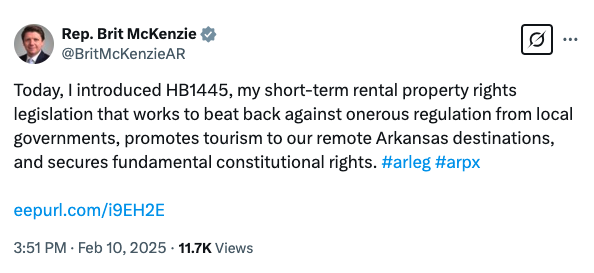
Arkansas HB 1445
The Arkansas State Legislature is considering a bill that would prohibit local governments, such as municipalities and counties, from enacting or enforcing any ordinance that effectively prohibits or limits the use of a property as a short-term rental.
Bill sponsor Rep. Bill McKenzie, in a post on X, described HB 1445 as “property rights legislation that works to beat back against onerous regulation from local governments, promotes tourism to our remote Arkansas destinations, and secures fundamental constitutional rights.”
During a hearing on Feb. 12, 2025, he stated that the bill would not “take away a single right of local law enforcement to enforce nuisance ordinances.”
The bill would allow local governments to revoke an STR license if the property has three nuisance ordinance violations.
Some local government officials testified in opposition to the bill, saying it would prevent them from adequately addressing citizen concerns and regulating STRs according to local needs.
The City, County, & Local Affairs Committee passed the bill 11-9 on Feb. 12, 2025, after the nearly three-hour hearing.
Final update: HB 1445 was never considered by the full House of Representatives before the end of the Arkansas legislative session on May 5, 2025, so the bill is now dead.
Colorado HB 25-1247
House Bill 25-1247 would increase the cap on the county lodging tax from 2% to 6%. The tax applies to the purchase price for rooms or accommodations, including short-term rentals. If the bill is approved, any county in Colorado could raise the tax to up to 6% with voter approval.
Revenue from the tax currently may be used for:
Local tourism promotion
Housing and childcare for tourism workers
Facilitating or enhancing visitor experiences
Under HB25-1247, the revenue could also be used for:
Public infrastructure maintenance and improvements
Nature preservation and promotion of sustainable tourism practices
Cultural and historical preservation
Public safety
The Colorado House of Representatives approved the bill 42-20 on March 10, 2025, while the Senate approved the bill 44-18 on April 11, 2025.
“While lodging taxes already contribute significantly to state and local funding, this bill proposes expanding the allowable uses of these taxes in ways that may not align with the original intent of supporting tourism and lodging-related infrastructure,” Mile High Hosts said in an alert to members.
“We believe that if lodging tax revenue is increased, it should be allocated toward initiatives that directly address housing solutions, as this has been a key focus of recent regulations affecting short-term rentals. However, any changes to how these funds are used should be approached thoughtfully, ensuring they don’t place an unfair burden on guests and the vacation rental community.”
Revenue from the state Tourist Development Tax–a bed tax collected from guests staying in hotels, motels, and short-term rentals–currently funds local tourism marketing efforts through county Tourist Development Councils (TDCs).
HB 7033, a large tax package, would abolish all 62 of the state’s TDCs and redirect Tourist Development Tax revenue toward property tax credits, beginning in 2026, according to Florida Politics. Meanwhile, House Bill 1221 would make all Tourist Development Taxes automatically expire every eight years.
Both bills passed the Florida House of Representatives on April 25, 2025, and are now being considered in the Senate.
Final update: The Senate referred HB 7033 and HB 1221 to the Appropriations Committee, where both bills died on June 16, 2025.
Idaho S 1162
The Idaho Legislature is considering Senate Bill 1162, which bars cities and counties from passing any ordinance that prohibits short-term rentals. The legislation would allow local governments to enact ordinances to regulate STRs so long as the regulations “do not impose different restrictions or obligations on the short-term rentals than are imposed on single-family dwellings or similar structures not used as short-term rentals.” This bill would effectively prohibit ordinances that require:
Owner occupation
Professional property management
Caps on the number of STRs
Limits on the number of rented nights
Internal or external signage, notices, or diagrams
Notices to neighbors
Conditional use permits in a residential zone
The bill also classifies STRs as nontransient residential for zoning and building code purposes. Cities and counties may require STRs to apply for an annual business license with a fee of no more than $50 and may revoke the business license of any STR that has three or more ordinance violations in the previous 12 months.
The bill was approved by the Senate Local Government & Taxation Committee on March 21, 2025, with a recommended amendment. The Senate approved amendments to the bill on March 28, 2025. As of March 29, 2025, the final reading of the bill had not yet been scheduled.
Final update: The Senate defeated the bill 23-to-11 on April 1, 2025.
Kentucky SB 61
Senate Bill 61 would bar cities and counties from regulating the density of short-term rentals in their communities. The bill was initially created to make minor adjustments to state regulations on private swimming pools. However, Speaker of the House David Osborne filed an amendment on March 14, 2025, to limit municipalities’ power to regulate STRS.
The Kentucky House of Representatives approved the bill with the Speaker’s amendment on March 14. The bill was returned to the Senate for approval and was passed on second reading on March 27, 2025.
Final update: SB 61 did not pass a third reading before the end of the legislative session. According to the Speaker of the House’s Office, it could be reintroduced next session.
Maine LD 283
This bill in the Maine State Legislature would redirect 1% of meals and lodging sales tax revenue to municipalities. In an email to members, the Vacation Rental Professionals of Maine described the legislation as a “de facto sales tax without local input.” The group said LD 283 would siphon revenue away from tourism marketing, “weakening Maine’s ability to attract visitors” during a time when tourism has dropped 9%.
The bill would also allow government agencies to bypass direct community input, “setting a precedent for future tax increases,” the alliance wrote.
Final update: LD 283 was voted down in the Committee on Taxation on March 11, 2025.
Missouri HB 1086
House Bill 1086 would classify short-term rentals as residential real property under state law. The bill was proposed by the Missouri Vacation Home Alliance in response to some county assessors arbitrarily reclassifying vacation home rentals as commercial because of a loophole in the tax code.
Tyann Marcink Hammond, President of the MOVHA board and Owner of Branson Family Retreats, said one of her vacation home rental property tax bills rose from $4,380 in 2022 to $10,680 in 2023 because of such an arbitrary reclassification to commercial.
“The use hasn’t changed when a home is occupied for short periods of time instead of long periods,” she said during a testimony on the bill on Feb. 13, 2025. “Yet some county tax assessors feel that a vacation rental should be classified as commercial use. The business aspect of a vacation home rental is not at the property. The same as a long-term rental, the business aspects of marketing, accounting, and customer service do not happen at the property but at an office.”
The House of Representatives passed the bill 118-34 on March 6, 2025, and the bill unanimously passed a Senate committee hearing on May 1, 2025.
Final update: HB 1086 came close to materializing this year but didn’t make it over the finish line. The bill stalled in the final days of the 2025 legislative session due to unrelated political drama.
MOVHA already has a strategy to reintroduce the bill in the next session, which begins in January 2026. In the meantime, the group is working locally to mitigate the fallout. Kansas City, a 2026 FIFA World Cup host city, recently approved a postponement of commercial tax reclassification thanks to advocacy from Susan Brown, MOVHA Vice President and President of the Kansas City Short-Term Rental Alliance.
New Mexico HM 52
House Memorial 52 would establish a Short-Term Rental Work Group and require the Economic Development Department, the Tourism Department, and the Taxation and Revenue Department to collaboratively study STR economic contributions, workforce housing solutions, and taxation policies. By Dec. 1, 2025, the work group will be expected to present their findings and policy recommendations to state lawmakers.
The bill also would require county assessors to suspend reclassifying short-term rentals from residential to commercial until the study is completed, preventing steep tax hikes that might later need to be reversed. Some New Mexico county assessors have begun reclassifying short-term rentals to commercial, removing the 3% annual property value cap that protects homeowners from drastic increases. Commercial property tax rates could destabilize homeowners “who rely on short-term rental income to meet mortgages, property taxes, and upkeep costs,” according to the New Mexico Short-Term Rental Association.
“This [bill] is a significant first step toward safeguarding short-term rentals in New Mexico and ensuring a fair and balanced approach to our industry,” NMSTRA wrote in an alert to members.
The House passed the Memorial 63-0 on March 22 and did not require Senate approval to move forward. Final update: Members of the work group were appointed and will be required to report findings and policy recommendations to the appropriate interim legislative committees by Dec. 1, 2025.
Ohio SB 104 and HB 109
Two identical bills in Ohio’s House and Senate would prohibit local jurisdictions from banning short-term rentals.
Sen. Andrew Brenner, a licensed real estate agent, reintroduced the legislation from the last session, according to a report by Journal-News.
SB 104 and its twin, HB 109, sponsored by Rep. Justin Pizzulli,
The bills would prohibit local governments from adopting ordinances that would:
Ban or cap short-term rentals in residential zones;
Provide STR permits based on a lottery system;
Restrict the number of STR properties one person can operate;
Require owners to occupy short-term rental properties.
The bills permit local jurisdictions to require STR licenses and adopt ordinances to regulate health and safety. They also expand lodging taxes to short-term rentals.
Lodging tax revenues “may increase from $121 million to $150 million annually due to the bill’s mandatory extension of the tax to short-term rental properties rather than just hotels,” according to an LSC fiscal analysis.
“It generates extra revenues for homeowners who may be having a hard time paying their property taxes, given the high level of property taxes that we see today,” Sen. Brenner said in a quote to Journal-News. “So I think that’s another reason why we need to allow short-term rentals to continue in the state of Ohio.”
If enacted into law, the legislation would overturn a ban on short-term rentals in residential neighborhoods in Richmond Heights. SB 104 was assigned to the Senate Local Government Committee, which has held three hearings but no votes on the legislation. The last hearing was on May 28, 2025. HB 109 was assigned to the House Development Committee. The House Committee on Development held a hearing on March 26, 2025, but has not acted on the bill. The Ohio Legislature remains in session until December.
Vermont H.242
H.242 in the Vermont State Legislature proposes to redefine short-term rentals and restrict STR activity to owner-occupied properties.
“This proposal would put 100% of Vermont vacation rental managers (aka thousands of Vermonters) out of work and cost the state hundreds of millions in tax revenue and visitor spending,” Julie Marks wrote in an alert to members of the Vermont Short-Term Rental Alliance.
One VSTRA member said they hoped the bill would be “dead on arrival,” given that vacation rentals contribute $460 million annually to the state’s GDP, support 6,000 jobs, spur $650 million in visitor spending each year, and generate $54 million a year in Meals & Rooms tax revenue.
“Most likely, we will not see legislators consider this proposal this session, but it will remain viable to be considered by the same legislative committee next session,” Julie said. “Actions like these demonstrate that our legislators continue to undervalue vacation rental tourism in our state. Short-term rentals provide over 60% of our visitor capacity while only occupying 3% of our housing stock. Our work is far from over.”
Final update: The bill was assigned to the Committee on General and Housing on Feb. 18, 2025, but was not acted upon before the end of the legislative session on May 9, 2025.
Washington SB 5576
SB 5576 in the Washington State Legislature would replace the statewide short-term rental tax with an optional local excise tax on the sale of lodging of short-term rentals through a short-term rental platform at a rate of up to 4% to use for affordable housing programs. It also would require a county or city imposing the tax to publish an annual report detailing how tax revenues were spent in the prior year.
The original proposal would have levied a 6% excise tax. However, the bill was amended to 4% on Feb. 27, 2025, after a public hearing on Feb. 25, where STR operators spoke about how the tax would impact them.
Before the hearing, the Washington Hosts Collaborative Alliance urged members to speak to lawmakers “about how this tax would harm small business owners, homeowners, and the local economy.
“Many STR operators share their homes to help cover costs, and the majority of guests are Washington residents who would also feel the impact of this tax,” the alliance noted in an alert to members.
The Senate approved the bill 27-21 on March 11. The House Committee on Finance approved the bill with amendments on March 27, 2025. The bill will now proceed to the full House of Representatives for a vote.
Final update: The session ended on April 27, 2025, without final approval for the bill.
BRnX Verified. BRnX Accredited. BRnX Trusted. That’s how you meet the new traveler where they are.
A. The short-term rental home use is permitted in no more than two single-family dwelling units per lot, except that short-term rental use shall not be permitted in any accessory dwelling pursuant to chapter 19.35 of this title. No more than one short-term rental home permit shall be approved for any lot, except when lots are subject to a condominium property regime pursuant to chapter 514A or 514B, Hawaii Revised Statutes, the following shall apply:
1. If the applicant owns all condominium units on the lot, only one permit may be granted for that lot.
2. If the applicant does not own all condominium units on the lot, each condominium unit will be considered a lot for purposes of this chapter and each unit owner will be eligible to apply for a short-term rental home permit, except that no owner may hold more than one short-term rental home permit.
3. Irrespective of ownership, each condominium unit shall be considered a separate lot for purposes of notification and planning commission review thresholds pursuant to subsection 19.65.060(A)(2).
4. For the purposes of this chapter, any reference to a short-term rental home property shall mean a property, lot, or condominium unit.
B. Each permitted dwelling unit on a short-term rental home property shall be rented to one group with a single rental agreement, except:
1. On the island of Lanai.
2. Any short-term rental home where the owner resides on an adjacent lot.
C. The permit holder shall have a current transient accommodations tax license and general excise tax license for the short-term rental home.
D. The permit holder shall:
1. Hold a minimum of a 50 percent interest in the legal title to the lot on which the short-term rental home is located, except as provided in subsection 19.65.030(G).
2. Serve as manager of the short-term rental home; provided that, the permit holder may designate:
a. An immediate adult family member of the permit holder to serve as manager. Immediate family includes a person’s parents, spouse, children and their spouses, siblings, stepparents, stepchildren, adopted children and their spouses, and hanai children.
b. An individual with an active State of Hawaii real estate license to serve as manager, except for properties located in the Hana or Lanai community plan areas, where an individual may act as a manager as allowed by State law.
c. An adult to serve as a temporary manager for up to forty-five days in a twelve-month period.
3. The permit holder shall notify the department and the immediate adjacent neighbors of:
a. Any designation of an individual as manager pursuant to this section, including a statement of the designated manager’s tenure, residential and business addresses, and telephone numbers.
b. Any change in the manager’s addresses or telephone numbers.
E. The manager of the short-term rental home shall:
1. Be accessible to guests, neighbors, and County agencies. For purposes of this section, “accessible” means being able to answer the telephone at all times, being able to be physically present at the short-term rental home within one hour following a request by a guest, a neighbor, or a County agency, and having an office or residence within thirty driving miles.
2. Ensure compliance with State department of health regulations, this chapter, permit conditions, and other applicable laws and regulations.
3. Enforce the house policies.
4. Collect all rental fees.
F. The short-term rental home shall only be rented when the manager is accessible.
G. The short-term rental home permit is issued in the name of the applicant, who shall be a natural person or persons holding a minimum of a 50 percent interest in the legal title in the lot; except that, a permit may be issued for a lot owned by a family trust, a corporation, a limited liability partnership, or a limited liability company if the following criteria are met:
1. The applicant is a natural person or persons who is a trustee or who are trustees of the family trust, or who represents 50 percent or more of the partners of a limited liability partnership, 50 percent or more of the corporate shareholders of a corporation, or 50 percent or more of the members of a limited liability company.
2. The limited liability partnership, corporation, or limited liability company is not publicly traded.
3. All of the trustees, partners, corporation’s shareholders or limited liability company’s members are natural persons, and if there is more than one trustee, partner, shareholder, or member, they shall be related by blood, adoption, marriage, or civil union.
H. An applicant may hold no more than one short-term rental home permit, except when:
1. Additional permits are for short-term rental homes that each have a County assessed market value of $3,200,000 or higher at the time of each application.
2. The permit holder filed complete applications for the short-term rental home permits within one year of this chapter’s original effective date of May 23, 2012.
I. A permit is not transferable; except a permit may be transferred upon the death of a permit holder to an immediate family member as defined in subsection 19.65.030(D)(2)(a).
J. The applicant shall provide with the application, copies of any applicable homeowner or condominium association bylaws or rules and any other applicable private conditions, covenants, or restrictions. The documents, if any, shall assist the department in determining the character of the neighborhood.
K. The number of bedrooms used for short-term rental home use on a short-term rental home lot shall be no greater than six on Lanai and Maui, and no greater than three on Molokai. The total number of guests staying in the short-term rental home at any one time shall be no greater than two times the number of bedrooms.
L. Single-station smoke detectors shall be installed in all guest bedrooms.
M. Single-family dwellings used as short-term rental homes shall not qualify for real property tax exemptions permitted pursuant to chapter 3.48 of this code.
N. Short-term rental homes shall conform to the character of the existing neighborhood in which they are situated. Prior to issuing a permit, the department or applicable planning commission shall consider the following:
1. If a proposed short-term rental home property is subject to any homeowner, condominium association, or other private conditions, covenants, or restrictions, then correspondence from the association or other entity responsible for the enforcement of the conditions, covenants, or restrictions is required. The correspondence shall include specific conditions that determine whether or not the proposed short-term rental home use is allowed. The correspondence shall be used to assist the department in determining the character of the neighborhood. If no such association or entity exists, this requirement shall not apply. The director and the planning commissions shall not be bound by any private conditions, covenants, or restrictions upon the subject parcel. Any such limitations may be enforced against the property owner through appropriate civil action.
2. Existing land-use entitlements and uses.
3. The applicable community plan.
4. Community input.
5. Potential adverse impacts, including excessive noise, traffic, and garbage.
6. The number of permitted short-term rental homes surrounding the proposed short-term rental home property and their distance to the property.
7. The number and substance of protests to the short-term rental home application and protests related to the cumulative short-term rental homes in the neighborhood or area.
8. Existing or past complaints about rental operations on the property.
9. Existing or past noncompliance with government requirements and the degree of cooperation by the applicant to become compliant.
O. Short-term rental homes shall be limited to single-family dwelling units constructed at least five years prior to the date of application for the short-term rental home permit, and the dwelling unit shall be owned by the applicant for at least five years prior to the date of application.
P. A two-square-foot sign shall be displayed along the main access road of the short-term rental home identifying the valid short-term rental home permit, a twenty-four-hour telephone number for the owner or the manager, and a telephone number for the department. The signs shall not be subject to the provisions of chapter 16.13 of this code.
Q. The permit holder or manager shall prominently display “house policies” within the dwelling. The house policies shall be included in the rental agreement, which shall be signed by each registered adult guest. At a minimum, the house policies shall include:
1. Quiet hours from 9:00 p.m. to 8:00 a.m., during which time the noise from the short-term rental home shall not unreasonably disturb adjacent neighbors. Sound that is audible beyond the property boundaries during non-quiet hours shall not be more excessive than would be otherwise associated with a residential area.
2. Amplified sound that is audible beyond the property boundaries of the short-term rental home is prohibited.
3. Vehicles shall be parked in the designated onsite parking area and shall not be parked on the street.
4. No parties or group gatherings other than registered guests shall occur.
R. The County shall be restricted in approving the number of permits for short-term rental homes as distributed per the following community plan areas and as further restricted by the applicable community plan:
1. Hana: 30.
2. Kihei-Makena: 100; with no more than five permitted short-term rental homes in the subdivision commonly known as Maui Meadows.
3. Makawao-Pukalani-Kula: 40.
4. Paia-Haiku: 88.
5. Wailuku-Kahului: 36.
6. West Maui: 88.
The council shall review the community plan short-term rental home restrictions when the number of approved short-term rental homes exceeds 90 percent of the restriction number. Short-term rental homes operating with a conditional permit pursuant to chapter 19.40 of this title that meet the criteria of this section shall be included in the number of short-term rental homes permitted pursuant to this subsection.
S. Prior to issuing a permit, the director or planning commission may impose conditions for a short-term rental home if the conditions are reasonably designed to mitigate adverse impacts to the neighborhood.
T. Any dwelling unit developed pursuant to chapter 201H, Hawaii Revised Statutes, or chapter 2.96 of this code shall not be used as a short-term rental home.
BRnX Verified. BRnX Accredited. BRnX Trusted. That’s how you meet the new traveler where they are.
Florida’s tourism industry is a major driver of its economy, attracting millions of visitors each year. To regulate businesses and protect consumers, the state has established laws impacting hotels, vacation rentals, theme parks, cruise lines, and other tourism-related enterprises. These regulations ensure safety, fairness, and compliance with local policies.
Understanding these legal requirements is essential for both business owners and visitors to avoid fines or disputes.
Hospitality Business Licensing
Operating a hospitality business in Florida requires compliance with licensing regulations enforced by the Florida Department of Business and Professional Regulation (DBPR). Hotels, motels, bed-and-breakfasts, and other lodging establishments must obtain a public lodging license under Chapter 509 of the Florida Statutes. Licensing fees vary based on the number of rental units, with a hotel of 51-75 rooms paying $325 annually, while smaller establishments with fewer than 25 rooms pay $175. Businesses must also pass inspections to ensure compliance with health and safety standards.
Food service establishments within hospitality businesses require a separate license from the DBPR’s Division of Hotels and Restaurants. Compliance with sanitation requirements outlined in Rule 61C-1 of the Florida Administrative Code is mandatory, including regular inspections and adherence to food safety protocols. Failure to maintain proper licensing can lead to fines or suspension of operations.
Liquor licensing is another requirement for hospitality businesses serving alcohol. The Division of Alcoholic Beverages and Tobacco (ABT) issues various liquor licenses, such as the 4COP-SFS license for restaurants generating at least 51% of their revenue from food sales. Fees vary by county, ranging from $624 to over $1,800 annually. Businesses must also comply with the Responsible Vendor Act, which promotes alcohol safety training to reduce liability risks.
Short-Term Rental Restrictions
Florida balances property owners’ rights with tourism industry interests through short-term rental regulations. While state law prevents local governments from banning vacation rentals, municipalities can enforce zoning, occupancy limits, and registration requirements. Miami Beach and Orlando, for example, impose minimum stay requirements and licensing mandates.
Property owners in many counties must register their rentals and obtain a local business tax receipt. Safety compliance, including fire alarms, carbon monoxide detectors, and proper egress routes, is mandatory. Some jurisdictions also require guest logs and periodic inspections. Homeowners’ associations and condominium boards may impose additional restrictions, such as minimum rental periods or board approval requirements. Violations can result in fines, property liens, or legal disputes.
Amusement and Theme Park Requirements
Florida’s amusement and theme parks must comply with safety and accessibility regulations. The Florida Department of Agriculture and Consumer Services (FDACS) oversees amusement rides under Chapter 616 of the Florida Statutes, requiring annual inspections for most attractions. Major theme parks like Walt Disney World, Universal Orlando, and SeaWorld are exempt from state inspections if they employ at least 1,000 full-time workers and maintain internal safety programs. However, they must report injuries and accidents under the Fair Rides Inspection Program.
Theme parks must also adhere to the Americans with Disabilities Act (ADA) and Florida-specific accessibility laws, ensuring wheelchair-accessible pathways, auxiliary aids for hearing-impaired guests, and accommodations for cognitive disabilities. The Unruh Civil Rights Act prohibits discrimination in public accommodations, requiring equal access policies.
Liability waivers are commonly used by amusement parks but do not protect against claims of gross negligence or willful misconduct. Florida courts have ruled that general disclaimers cannot absolve businesses from responsibility if safety standards are knowingly disregarded. This legal framework encourages strict ride operator training, maintenance schedules, and emergency response protocols.
Cruise Regulations
Florida, home to major cruise ports in Miami, Fort Lauderdale, and Port Canaveral, regulates cruise operations through state and federal laws. The Florida Uniform Port Access Code standardizes vessel entry and exit procedures to enhance security and environmental protection. The Florida Seaport Transportation and Economic Development (FSTED) Program funds infrastructure improvements to accommodate larger cruise ships.
Passenger safety falls under the federal Cruise Vessel Security and Safety Act (CVSSA), which mandates crime reporting, cabin security measures, and trained medical personnel for handling sexual assault cases. Florida reinforces these protections by requiring cruise terminals to comply with state accessibility laws and emergency preparedness standards. Environmental regulations restrict waste discharge within Florida waters to protect marine ecosystems.
Consumer Protection in Tourism Marketing
Florida’s tourism marketing is regulated to prevent deceptive advertising and ensure transparency. The Florida Deceptive and Unfair Trade Practices Act (FDUTPA) prohibits false or misleading promotions, requiring businesses to disclose all material terms of an offer. For example, if a resort advertises an all-inclusive stay, it must clearly define what is included and disclose additional fees. FDUTPA violations can result in fines of up to $10,000 per offense, with higher penalties for targeting seniors or individuals with disabilities.
Timeshare sales, a key part of Florida’s tourism economy, are governed by the Florida Vacation Plan and Timesharing Act. This law mandates a five-day rescission period for buyers to cancel a purchase without penalty and requires full disclosure of maintenance fees, special assessments, and usage restrictions. The Florida Attorney General’s Office actively investigates fraudulent timeshare resale schemes, imposing fines and ordering restitution for affected consumers.
Personal Injury Liability
Tourism-related businesses in Florida must adhere to premises liability laws, which hold property owners responsible for maintaining safe environments. If a tourist is injured due to unsafe conditions—such as a wet floor without warning signs or faulty equipment—the business may be held liable. Florida follows a modified comparative negligence rule, barring recovery if the injured party is more than 50% responsible for their injury.
Slip and fall cases, a common source of litigation, require injured parties to prove that a business had actual or constructive knowledge of a hazardous condition and failed to address it. Cruise ships operate under maritime law, often involving federal jurisdiction. Recreational activities such as parasailing and jet skiing are regulated under Chapter 327 of the Florida Statutes, requiring operators to carry liability insurance and follow safety guidelines. Noncompliance can result in lawsuits, regulatory fines, or criminal penalties for gross negligence.
Tourism Tax Provisions
Florida imposes several tourism-related taxes affecting businesses and visitors. The Tourist Development Tax, or “bed tax,” applies to short-term rentals, hotels, and resorts, with rates ranging from 2% to 6% depending on the county. Revenue funds local tourism promotion, beach restoration, and infrastructure projects. Businesses that fail to collect and remit this tax face penalties, including fines and potential legal action from the Florida Department of Revenue.
A 6% state sales tax applies to most goods and services, including theme park tickets, guided tours, and boat rentals. Some counties impose an additional discretionary surtax. Rental car transactions are subject to a separate $2 per day surcharge, which funds transportation projects. Businesses must maintain accurate records and file timely tax reports to avoid audits and penalties.
BRnX Verified. BRnX Accredited. BRnX Trusted. That’s how you meet the new traveler where they are.
A new ordinance in Summit County, Colorado, requires short-term rental (STR) marketplaces such as Airbnb and Vrbo to include a valid county STR permit number in all property listings. Under the ordinance, marketplaces must also delete illegal listings when notified by county officials. While the measure doesn’t change the county’s STR regulations, it offers the county a new avenue for enforcing the rules. With limited resources, enforcement has been a challenge for county authorities.
The ordinance follows on the heels of a statewide law passed in 2023 that gave counties authority to a regulate vacation rental service, defined as “a person that operates a website or any other digital platform that provides a means through which an owner or owner’s agent may offer lodging, unit, or portion thereof for short-term rentals and from which the person financially benefits.”
The law allows counties specific powers to require STR marketplaces to help them enforce rules around licensing. Other Colorado jurisdictions — including Boulder, Douglas, Clear Creek, and Larimer counties — have used this legislation as a springboard to craft laws similar to Summit County’s.
Colorado isn’t the only government using regulation of STR marketplaces to aid in enforcement of STR laws. Other jurisdictions that have passed similar laws recently include Monterey, California, San Antonio, Texas, and Rhode Island.
County regulations require operators to be licensed
Designate an agent responsible for responding to problems with the rental within an hour
Follow safety, occupancy, and parking rules
The ordinance established a Neighborhood Overlay Zone and a Resort Overlay Zone for STRs, with stricter rules in the neighborhood zone in terms of limits on numbers of licenses and the number of nights per year properties can operate as STRs. The majority of STRs in the county are located in the resort zone, which includes Keystone, Copper Mountain, Tiger Run Resort, and unincorporated areas at the base of Peak 8 in Breckenridge.
Lodging tax compliance for Summit County short-term rental hosts
In addition to following operational rules, Summit County vacation rental owners must register for a tax license with the state and collect state sales tax from guests. STRs are also subject to a Summit County short-term rental lodging tax that was approved by voters in 2022. STR operators are responsible for collecting all required taxes and submitting them to the proper tax authorities, unless their STR marketplace collects taxes for them.
In Summit County, Airbnb and Vrbo automatically collect state and county lodging taxes for their hosts when guests pay. Even if a rental marketplace collects lodging taxes, Colorado hosts are still required to register for a state tax license and file regular lodging tax returns.
MyLodgeTax can automate and simplify short-term rental tax compliance, including registration and filing with state and local tax authorities. For more on short-term rental taxes in Colorado, see our Colorado vacation rental tax guide. If you have tax questions related to vacation rental properties, drop us a line and we’ll get back to you with answers.
BRnX Verified. BRnX Accredited. BRnX Trusted. That’s how you meet the new traveler where they are.
Under Resolution MH-DGT-RES-0025-2024, any digital platform that lists or processes payments for short-term rentals must verify the information of their hosts and submit an annual report to the Tax Administration.
In practice, this means platforms will begin asking you to confirm or update your personal and property details. They’ll also cross-check that information against public records to make sure everything lines up.
For property owners and hosts, it’s important to understand what this regulation involves and how to stay compliant.
Why this matters and how can it affect you:
Costa Rica’s Tax Administration has formalized new reporting duties for “Digital Platform Operators” (think Airbnb-style marketplaces and listing/payment platforms). These operators must collect, validate, and report specific data about reportable sellers (hosts/owners who rent property) each year. Failure to report can trigger fines of 2% of the prior year’s gross income, with a minimum of 3 and a maximum of 100 base salaries. If the missing info is filed within 3 days after the deadline, the fine may be reduced by 75%.
What Changed?
Before: Hosts and property managers simply had to register and declare taxes on their own, and many slipped under the radar.
Now: Platforms themselves must verify and report your information directly to the Tax Administration. Non-compliance is no longer invisible.
You count as a reportable seller if you meet any of these conditions: a) you reside in Costa Rica or a reportable jurisdiction, b) you rent out real estate located in Costa Rica, and/or c) you receive payments in Costa Rica or a reportable jurisdiction for those rentals. Platforms that are Costa Rican tax residents, incorporated or managed from Costa Rica, or that facilitate rentals in Costa Rica are within scope of these new duties.
What does platforms must collect from you:
Platforms will request and verify at least the following from hosts and property managers:
Full legal name and primary address
Costa Rican taxpayer ID (NITE/DTI)
Date of birth (individuals) or registration date (companies)
Property details. All information must be consistent with the National Registry.
This information must be reported by the platforms to the Tax Administration by January 31 of the year after the activity occurred (i.e., 2025 activity reported by January 31, 2026).
Information related to a reportable seller will not be shared with the Costa Rican Tax Administration or the seller if the Reporting Platform Operator has obtained sufficient assurance that another platform is fulfilling the reporting obligations.
How this fits with your existing obligations:
These platform reports do not replace your ordinary duties as a host or owner. You still need to:
a. Register with the Tax Administration (as individual or entity) for short-term rental activities.
Every host or owner offering short-term stays in Costa Rica must register with the Tax Administration (Ministerio de Hacienda) as a taxpayer and activate the correct economic activity (short term rentals) in the virtual platform using the D-140 registration form. This applies to both individuals and companies. From registration onward, you are required to issue electronic invoices, maintain income and expense records, file monthly VAT returns where applicable, submit the annual income tax return, and pay your taxes accordingly.
b. Align with municipal licensing rules and any ICT requirements that apply to your rental model.
Short term rentals must register with the Costa Rican Tourism Institute (ICT) in the Non-Traditional Rental Registry before operating; the filing is completed online and ICT issues an inscription resolution and user code. Operating without registering, or failing to keep your record updated within one month of any change, constitutes illegal operation under the framework law. ICT maintains a public, searchable registry and shares the data electronically with the Tax Administration for enforcement and tax control.
Additionally, depending on the canton, your activity may be treated as a commercial service that requires a municipal business license (“patente”). Where applicable, you must obtain the patente from the local municipality before operating or advertising, and keep it current. Operating without a patente where one is required can lead to local fines, closures, or enforcement actions, so confirm the rules with your specific municipality.
c. Use compliant contracts (e.g., guest agreements, liability waivers) and keep clear revenue records.
Quatro Legal is here to help you stay compliant, protected, and informed.
We offer the following services to help you either meet regulatory requirements or get started in the market:
Compliance with the Costa Rican Tourism Board (ICT).
Registration with the Tax Agency for short-term rentals.
Waiver of liability drafting.
Guidance on applicable rules and regulations.
Drafting of short-term rental agreements.
Assistance in obtaining a municipal commercial license.
BRnX Verified. BRnX Accredited. BRnX Trusted. That’s how you meet the new traveler where they are.
The Maui Planning Commission heard more than seven hours of often impassioned testimony Tuesday, then deliberated nearly three hours before advising the Maui County Council to approve a bill to phase-out 7,000 short-term rentals in apartment districts, mostly in South and West Maui.
In the end, the commission voted 5-0 to recommend ending the decades-long grandfathered use of vacation rentals in apartment districts; those on the so-called Minatoya List. The commission’s action comes as Maui faces a housing emergency in the wake of the August 2023 wildfires disaster and steep challenges in building more housing, hampered by high building costs, scarce water and wastewater availability and vacant lands.
“Our community is screaming for this,” said Commissioner Ashley Lindsey, who said she has experience in property management of both long- and short-term rentals.
“Our community needs housing first,” she said. “We need to take care of our people. We need to do what’s right for Maui.”
There’s “lots of money in short-term rentals,” she said. It’s a great investment that “basically pays for your retirement and whatever else you want to do.”
However, “we were always supposed to have apartments in those areas,” she said. “People have been lucky to have used those short-term rentals for other reasons (until now), but getting back our communities is the most important part of being part of a community.”
Commissioner Mel Hipolito Jr. said the issue has led to some soul searching.
“I need to really take a deep dive in my heart, in my mind about the future,” he said. The future of “our loved ones, our families, even our families that’s not born yet.”
Hipolito said he’s aware of potential legal challenges, but “I truly believe the mayor and his team have done their due diligence.”
As for concerns about the bill’s economic impacts, the County Council will have the opportunity to investigate and assess those, he said.
Commission Chair Kimberly Thayer noted that the commission is only making a recommendation to the County Council. “We are just one step in the road,” she said. “But we are, you know, an important part of the process.”
“Zoning is not meant to be static,” she said. “It is meant to change over time to reflect the needs of the community.”
Maui County’s zoning code is “very, very old” and “very out of date and in need of change to reflect the current trends in our community, the desires of our people,” Thayer said.
She said the debate over the vacation rentals phase-out has brought up questions such as: “Who are we, and what do we want to be? What kind of future do we want for our keiki?”
Hawaiʻi has gone from a purely subsistence economy to “commercialization of our land,” plantation agriculture, and tourism, Thayer said. Now, “we are not unique in kind of being at a crossroads… There’s communities all over the whole entire world who have had to evolve over time, and now is our time to look at evolving.”
Now, the way Maui’s zoning districts are structured, and “the way our land is quote, unquote ‘used’ is not serving us right now,” she said. “The question is: what is the highest and best use?”
“It’s bubbling up that the best thing for our island and for our people is to change this piece of zoning to kind of change our trajectory into the future,” Thayer said. “This is not a decision that is taken lightly at all… We’re not making this decision for any of us. We’re making this decision for everybody who comes after us.”
The commission’s recommendation includes asking the Council to consider economic impacts found in a study by the University of Hawaiʻi Economic Research Organization, known as UHERO. That study, sought by the Bissen administration, is expected to be ready in time for Council consideration of the bill later this year.
This morning, the Council’s Housing and Land Use Committee, chaired by Council Member Tasha Kama, discussed a proposed request for proposals to study the phase-out of short-term rentals in apartment-zoned districts.
The commission also wants the Council to consider social, cultural, environmental and quality of life impacts. Commissioners recommended that the Council exclude vacation rental properties that community plans designate for hotel use or properties that are partially zoned hotel.
Commission members discussed at some length giving South Maui short-term vacation rental owners more time — as much as three to five years — to phase-out the transient use. However, Hipolito said, “I feel the need is now.” And, the idea was dropped.
When asked Tuesday evening about the timing of the proposed phase-out, Bissen told commissioners it was his decision to choose the effective dates because they reflect the “urgency that this deserves.”
Some people say it’s overdue by 35 years, and now, “you cannot say this is an emergency that needs to be done right away, and (then) say, ‘Let’s take five years,’ ” Bissen said.
As proposed, housing units in apartment-zoned districts will no longer be permitted as short-term visitor accommodations — as of July 1, 2025, for West Maui, and Jan. 1, 2026, for the rest of Maui County.
In the coming months, the Council will receive a Department of Planning report in support of the mayor’s proposal, as well as minutes of commission meetings on June 25 and Tuesday. In those two days of hearings, more than 250 people testified for and against the measure. And, there are several hundred pages of written testimony. (To read written testimony, go to the end of the Planning Department’s report here. Additional written testimonies submitted include those that came after posting June 25 part 1; and part 2; July 9; and documents received after posting July 23 part 1 and part 2.)
On Tuesday, dozens of testifiers were roughly divided over whether residents or visitors should occupy apartments that have been used for decades as transient accommodations. Bill proponents maintained that it’s time to prioritize Maui’s resources, including housing and water, for residents, especially after the August 2023 wildfires that killed 102 in Lahaina and aggravated the island’s longtime housing shortage.
Bill opponents argued that eliminating vacation rentals in apartment-zoned districts would wreak widespread economic damage, lead to business closures and job losses, and threaten the livelihoods of owners dependent on income from their investment properties. They also said vacation rentals would not be converted to residential housing because they’re too expensive and inappropriate for housing because of a lack of living space, storage, parking and recreational areas.
Stephen Thiele, a Kamaole Sands condominium owner, asked the commission to “reject this draconian and unconstitutional bill.”
“This bill stands on the thin ice of a falsehood that the Minatoya properties were built for long-term workforce housing,” he said. “However, the facts are that many of these properties were clearly built to be vacation resorts, operated and managed by hotel companies.”
Thiele said a housing report submitted to the commission contains no information about skyrocketing apartment owner association fees and lacks a full analysis of devastating economic impacts if the bill were to become law. He predicted a class-action lawsuit, based on the constitutionality of taking away a recognized property right.
Maui Tomorrow Foundation Executive Director Albert Perez said decision-makers have ignored the policy of keeping the island’s visitor population below 33% of the resident population while also disregarding the purpose of apartment-zoned districts to provide high-density housing for long-term residents.
Decision-makers need to stop “approving luxury housing,” he said. “It uses up our infrastructure and brings more wealthy people who can pay more for everything.”
Perez cited a UHERO estimate that the phase-out bill would increase Maui’s housing inventory by 13%, “a dramatic increase that will lower housing prices, whether for sale or for rent.”
UHERO also says short-term rentals are operated by those who run multiple vacation properties who would likely sell or rent their units. “So many properties would likely be converted to long-term use,” Perez said.
While addressing commissioners’ questions Tuesday, Bissen also responded to the argument that vacation rentals would not be converted to residential use.
If an apartment unit becomes either owner-occupied or a long-term rental, “I think by it’s very nature, they will go to somebody who resides on Maui.”
The goal is to increase residential housing inventory, and even if a small percentage of conversion from vacation rental to housing yields even 500 units, then “I’ll take that,” Bissen said.
However, he said he thought the number of homes for residents will be higher than a few hundred because even if an owner has two, three or five homes, “you can only live in one.”
“If you can only live in one, what are you going to do with the others?” he asked. “Keep ‘um vacant?” Then owners face losing money on their investments, he pointed out. “If you’re losing money using it as a short term, then maybe switch the model and rent it to somebody long-term.”
Bissen also said his administration is committed to enforcing laws against illegal vacation rentals. He pointed out that his administration reversed a policy not to investigate anonymous complaints. “We’re gonna take every complaint, even if it’s anonymous,” he said.
The mayor said zoning should reflect actual use. So, if some apartment complexes operate as hotels, then they should get hotel zoning, Bissen said. “I mean, if you walk like a duck, you quack like a duck and look like a duck, you’re a duck.”
For decades, Maui County’s policy has been to allow transient vacation rentals to continue operating, legally, in apartment-zoned areas meant for residential use. This has led to real estate speculation, rising property values and an industry in support of vacation rental promotion, sales, management, cleaning and maintenance.
The county currently permits vacation rentals in A1 and A2 apartment districts, provided that units are in buildings constructed before April 21, 1989, and that owners meet other criteria, such as paying higher real property taxes and transient accommodations taxes.
Former Hawaiʻi Attorney General David Louie testified in opposition to the bill on behalf of client Airbnb, giving commission members a preview of likely legal challenges to the measure if it becomes law.
“This bill will effectively eliminate STRs, despite the fact that STRs have been lawful residential uses for decades,” he said.
Deputy Corporation Counsel Michael Hopper told commissioners that the Legislature’s recent change in the law allows the county to amortize, or phase-out, nonconforming uses over a reasonable period of time. That came after a change in “some case law that came up recently.”
Residential uses cannot be phased-out, he said, but recently passed legislation says vacation rental use, as defined by respective counties, would not count as a residential use.
So the legislation “made clear that that type of use (vacation rentals) can be phased out over a reasonable period of time,” he said.
Louie disputed the contention that the enactment of Senate Bill 2919 has paved the way for legally phasing out vacation rentals.
In written testimony, Louie said statutory protections for vacation rental owners derive from constitutional law. Even after statutory protections are removed, “the constitutional foundation remains,” he said. “Maui’s proposed TVR bill likely violates such constitutional protections.”
“The proposed TVR bill is likely unlawful, violating well-established rights under the United States and State of Hawaiʻi constitutions, and would invite years of lawsuits,” he said. “Both the State of Hawaiʻi and federal courts of Hawaiʻi have explicitly recognized the vested rights of apartment owners to use their homes for short-term rentals. As such, there is a likelihood that the TVR bill [will be] ultimately deemed unconstitutional.”
On Tuesday, a number of testifiers expressed concern that the proposed phase-out of vacation rentals has become a divisive, “us-versus-them issue.” Some suggested finding a middle ground and ways to address Maui’s housing crisis, such as using revenue generated by vacation rentals to pay for infrastructure needed for residential housing development.
Bissen told commissioners that “the last thing we wanted to do from the administration is to divide our community… This is the time for us to be together.”
“The whole idea is to make the inventory available for people who choose to make Maui home,” he said.
The Molokaʻi Planning Commission has recommended approval of the vacation rental phase-out, including a caveat that, if the Council were not to approve it for Maui, that the ban would still apply to Molokaʻi. The Lānaʻi Planning Commission remained neutral on the bill, but provided comments.
Commission Vice Chair Dale Thompson, who has a vacation rental property, was absent Tuesday and did not participate in the commission’s deliberations. The nine-member commission has three vacant seats.
BRnX Verified. BRnX Accredited. BRnX Trusted. That’s how you meet the new traveler where they are.